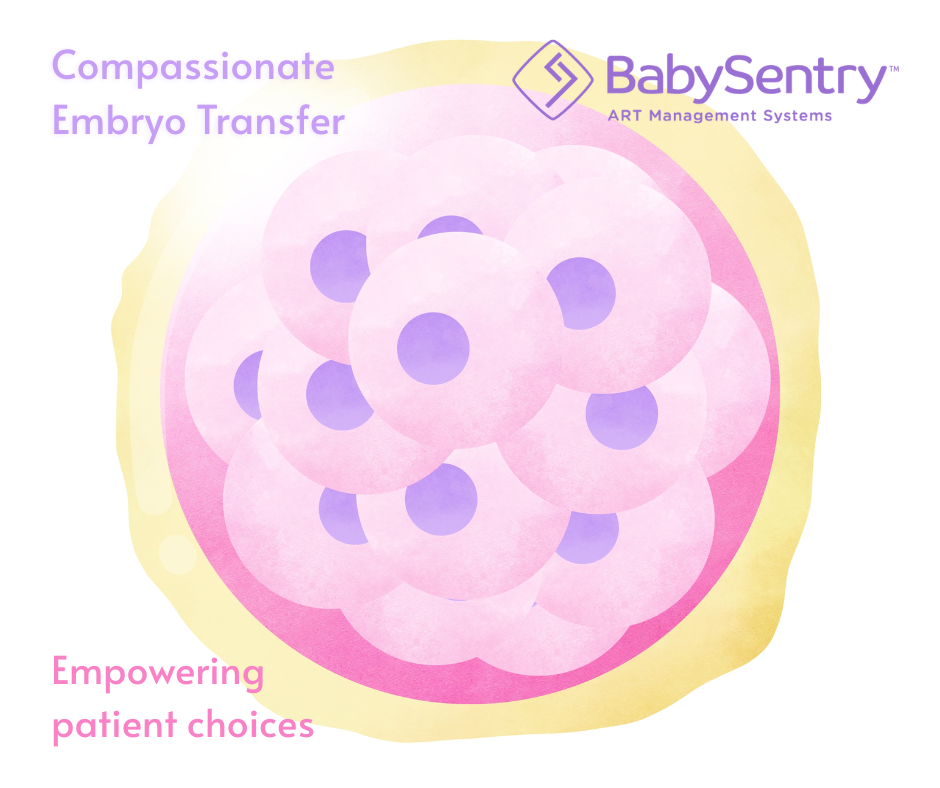
Compassionate embryo transfer (CET):
Refers to a patient’s request to transfer their cryopreserved embryos into their own body at a time or in a manner where pregnancy is highly unlikely to occur, and where the intention is not to achieve pregnancy.
It is essentially a way for some patients to say goodbye to their embryos in a manner that aligns with their emotional, moral, or spiritual values - rather than discarding them in the lab or donating them for research or reproduction.
Why patients request CET?
ASRM notes that these requests often arise from deeply personal, strongly held beliefs. Common motivations include:
- A desire for a more meaningful or embodied form of closure
- Discomfort with laboratory discard
- Ethical or religious beliefs about embryo status
- A wish to avoid indefinite cryopreservation
- Emotional attachment to embryos created during a significant life chapter
For some, CET feels like a respectful or compassionate way to complete the fertility journey.
What makes it “compassionate”?
CET is performed:
- At a time when implantation is extremely unlikely (e.g., late luteal phase)
- In a location where pregnancy cannot occur (e.g., cervix rather than uterus)
- With the explicit intention not to reproduce
The goal is embryo disposition, not pregnancy.
Ethical considerations
ASRM states that it is ethically permissible for clinicians to either honor or decline CET requests, as long as decisions are made nondiscriminatorily.
Key ethical principles involved:
- Reproductive liberty: respecting patient autonomy
- Physician autonomy: clinicians may decline based on conscience or clinical judgment
- Medical futility: pregnancy is not intended
- Nonmaleficence: ensuring no harm to the patient
- Distributive justice: fair use of resources
Clinics are encouraged to have clear policies and require informed consent for CET.
The bigger picture
CET sits at the intersection of:
- Ethics
- Emotion
- Embryo disposition
- Patient autonomy
- Clinical boundaries
It’s rare, but when it arises, it often reflects profound meaning for the patient.
BBS is now in-tune with CET procedures, ensuring full documentation and exclusion from registry submissions.
#ARTsystems
#ARTemr
#FertilityEMR
#FertilitySystems
#IVFcompassionate
#CETinIVF
#EmbryoDisposition
#IVFethics
#BabySentry